
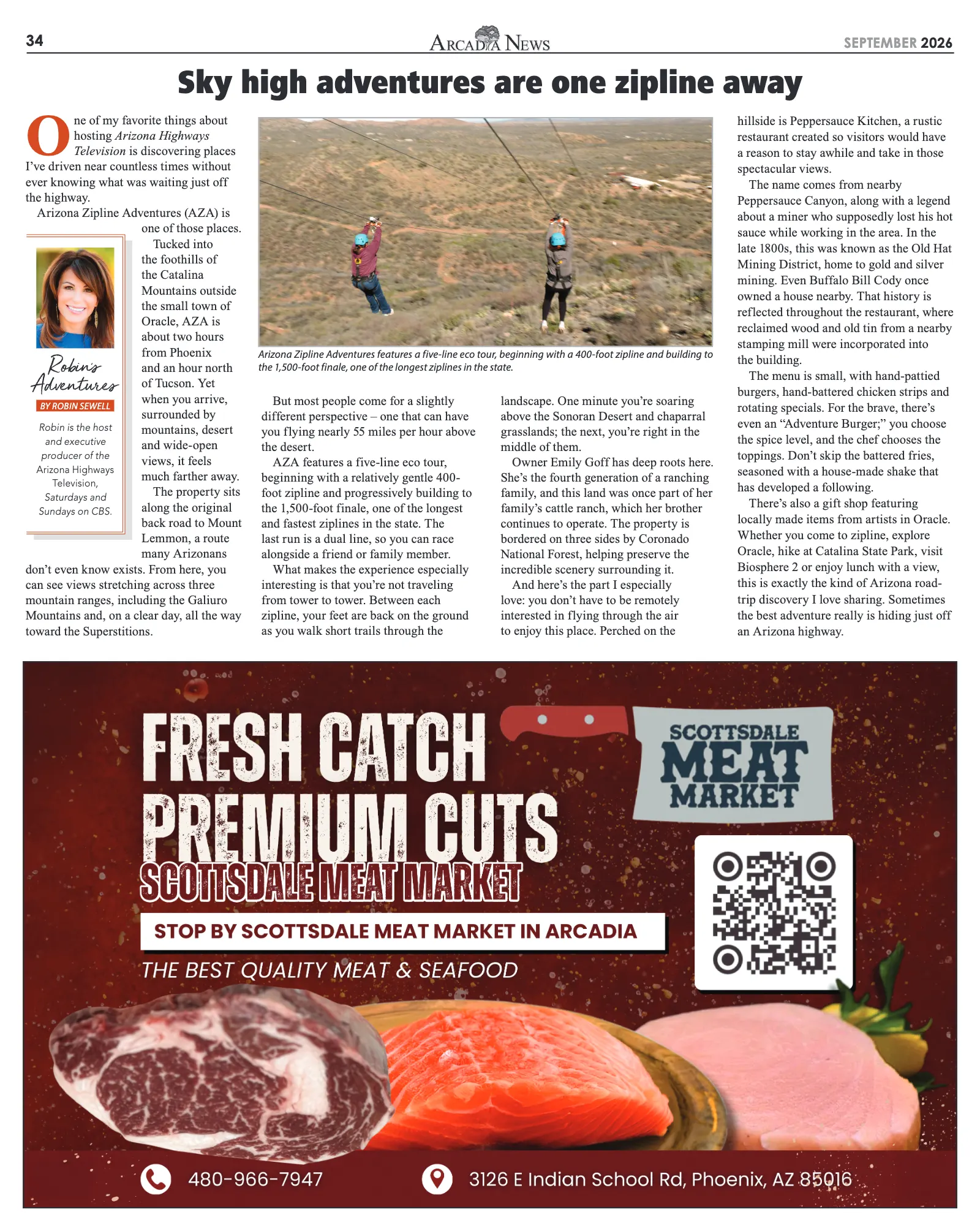
34 SEPTEMBER 2026 But most people come for a slightly different perspective – one that can have you flying nearly 55 miles per hour above the desert. AZA features a five-line eco tour, beginning with a relatively gentle 400- foot zipline and progressively building to the 1,500-foot finale, one of the longest and fastest ziplines in the state. The last run is a dual line, so you can race alongside a friend or family member. What makes the experience especially interesting is that you’re not traveling from tower to tower. Between each zipline, your feet are back on the ground as you walk short trails through the landscape. One minute you’re soaring above the Sonoran Desert and chaparral grasslands; the next, you’re right in the middle of them. Owner Emily Goff has deep roots here. She’s the fourth generation of a ranching family, and this land was once part of her family’s cattle ranch, which her brother continues to operate. The property is bordered on three sides by Coronado National Forest, helping preserve the incredible scenery surrounding it. And here’s the part I especially love: you don’t have to be remotely interested in flying through the air to enjoy this place. Perched on the O ne of my favorite things about hosting Arizona Highways Television is discovering places I’ve driven near countless times without ever knowing what was waiting just off the highway. Arizona Zipline Adventures (AZA) is one of those places. Tucked into the foothills of the Catalina Mountains outside the small town of Oracle, AZA is about two hours from Phoenix and an hour north of Tucson. Yet when you arrive, surrounded by mountains, desert and wide-open views, it feels much farther away. The property sits along the original back road to Mount Lemmon, a route many Arizonans don’t even know exists. From here, you can see views stretching across three mountain ranges, including the Galiuro Mountains and, on a clear day, all the way toward the Superstitions. hillside is Peppersauce Kitchen, a rustic restaurant created so visitors would have a reason to stay awhile and take in those spectacular views. The name comes from nearby Peppersauce Canyon, along with a legend about a miner who supposedly lost his hot sauce while working in the area. In the late 1800s, this was known as the Old Hat Mining District, home to gold and silver mining. Even Buffalo Bill Cody once owned a house nearby. That history is reflected throughout the restaurant, where reclaimed wood and old tin from a nearby stamping mill were incorporated into the building. The menu is small, with hand-pattied burgers, hand-battered chicken strips and rotating specials. For the brave, there’s even an “Adventure Burger;” you choose the spice level, and the chef chooses the toppings. Don’t skip the battered fries, seasoned with a house-made shake that has developed a following. There’s also a gift shop featuring locally made items from artists in Oracle. Whether you come to zipline, explore Oracle, hike at Catalina State Park, visit Biosphere 2 or enjoy lunch with a view, this is exactly the kind of Arizona road- trip discovery I love sharing. Sometimes the best adventure really is hiding just off an Arizona highway. Sky high adventures are one zipline away Robin is the host and executive producer of the Arizona Highways Television , Saturdays and Sundays on CBS. BY ROBIN SEWELL Arizona Zipline Adventures features a five-line eco tour, beginning with a 400-foot zipline and building to the 1,500-foot finale, one of the longest ziplines in the state.
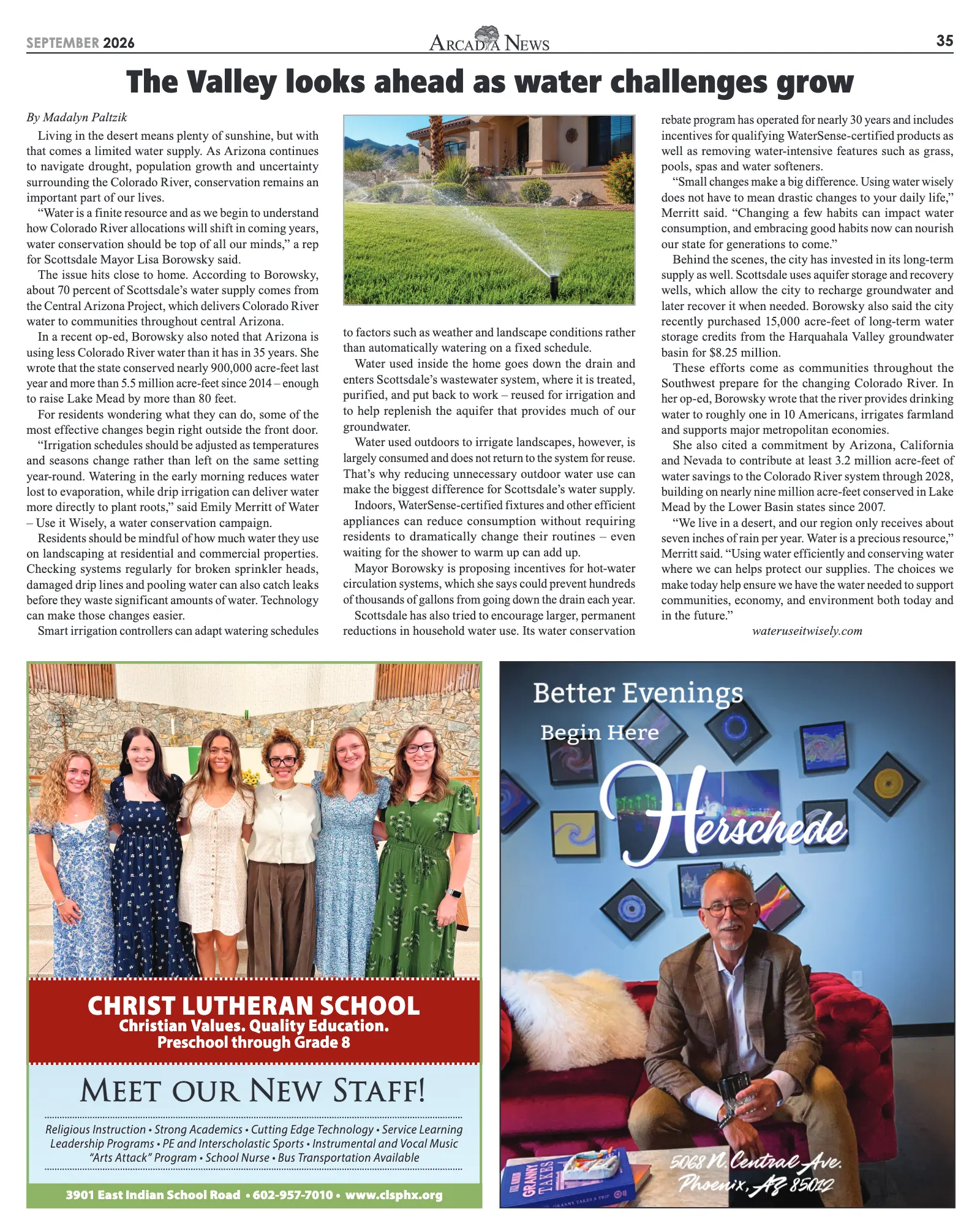
35 SEPTEMBER 2026 By Madalyn Paltzik Living in the desert means plenty of sunshine, but with that comes a limited water supply. As Arizona continues to navigate drought, population growth and uncertainty surrounding the Colorado River, conservation remains an important part of our lives. “Water is a finite resource and as we begin to understand how Colorado River allocations will shift in coming years, water conservation should be top of all our minds,” a rep for Scottsdale Mayor Lisa Borowsky said. The issue hits close to home. According to Borowsky, about 70 percent of Scottsdale’s water supply comes from the Central Arizona Project, which delivers Colorado River water to communities throughout central Arizona. In a recent op-ed, Borowsky also noted that Arizona is using less Colorado River water than it has in 35 years. She wrote that the state conserved nearly 900,000 acre-feet last year and more than 5.5 million acre-feet since 2014 – enough to raise Lake Mead by more than 80 feet. For residents wondering what they can do, some of the most effective changes begin right outside the front door. “Irrigation schedules should be adjusted as temperatures and seasons change rather than left on the same setting year-round. Watering in the early morning reduces water lost to evaporation, while drip irrigation can deliver water more directly to plant roots,” said Emily Merritt of Water – Use it Wisely, a water conservation campaign. Residents should be mindful of how much water they use on landscaping at residential and commercial properties. Checking systems regularly for broken sprinkler heads, damaged drip lines and pooling water can also catch leaks before they waste significant amounts of water. Technology can make those changes easier. Smart irrigation controllers can adapt watering schedules to factors such as weather and landscape conditions rather than automatically watering on a fixed schedule. Water used inside the home goes down the drain and enters Scottsdale’s wastewater system, where it is treated, purified, and put back to work – reused for irrigation and to help replenish the aquifer that provides much of our groundwater. Water used outdoors to irrigate landscapes, however, is largely consumed and does not return to the system for reuse. That’s why reducing unnecessary outdoor water use can make the biggest difference for Scottsdale’s water supply. Indoors, WaterSense-certified fixtures and other efficient appliances can reduce consumption without requiring residents to dramatically change their routines – even waiting for the shower to warm up can add up. Mayor Borowsky is proposing incentives for hot-water circulation systems, which she says could prevent hundreds of thousands of gallons from going down the drain each year. Scottsdale has also tried to encourage larger, permanent reductions in household water use. Its water conservation rebate program has operated for nearly 30 years and includes incentives for qualifying WaterSense-certified products as well as removing water-intensive features such as grass, pools, spas and water softeners. “Small changes make a big difference. Using water wisely does not have to mean drastic changes to your daily life,” Merritt said. “Changing a few habits can impact water consumption, and embracing good habits now can nourish our state for generations to come.” Behind the scenes, the city has invested in its long-term supply as well. Scottsdale uses aquifer storage and recovery wells, which allow the city to recharge groundwater and later recover it when needed. Borowsky also said the city recently purchased 15,000 acre-feet of long-term water storage credits from the Harquahala Valley groundwater basin for $8.25 million. These efforts come as communities throughout the Southwest prepare for the changing Colorado River. In her op-ed, Borowsky wrote that the river provides drinking water to roughly one in 10 Americans, irrigates farmland and supports major metropolitan economies. She also cited a commitment by Arizona, California and Nevada to contribute at least 3.2 million acre-feet of water savings to the Colorado River system through 2028, building on nearly nine million acre-feet conserved in Lake Mead by the Lower Basin states since 2007. “We live in a desert, and our region only receives about seven inches of rain per year. Water is a precious resource,” Merritt said. “Using water efficiently and conserving water where we can helps protect our supplies. The choices we make today help ensure we have the water needed to support communities, economy, and environment both today and in the future.” wateruseitwisely.com The Valley looks ahead as water challenges grow Religious Instruction • Strong Academics • Cutting Edge Technology • Service Learning Religious Instruction • Strong Academics • Cutting Edge Technology • Service Learning Leadership Programs • PE and Interscholastic Sports • Instrumental and Vocal Music Leadership Programs • PE and Interscholastic Sports • Instrumental and Vocal Music “Arts Attack” Program • School Nurse • Bus Transportation Available “Arts Attack” Program • School Nurse • Bus Transportation Available Meet our New Staff! Meet our New Staff! 3901 East Indian School Road • 602-957-7010 • www.clsphx.org CHRIST LUTHERAN SCHOOL Christian Values. Quality Education. Preschool through Grade 8