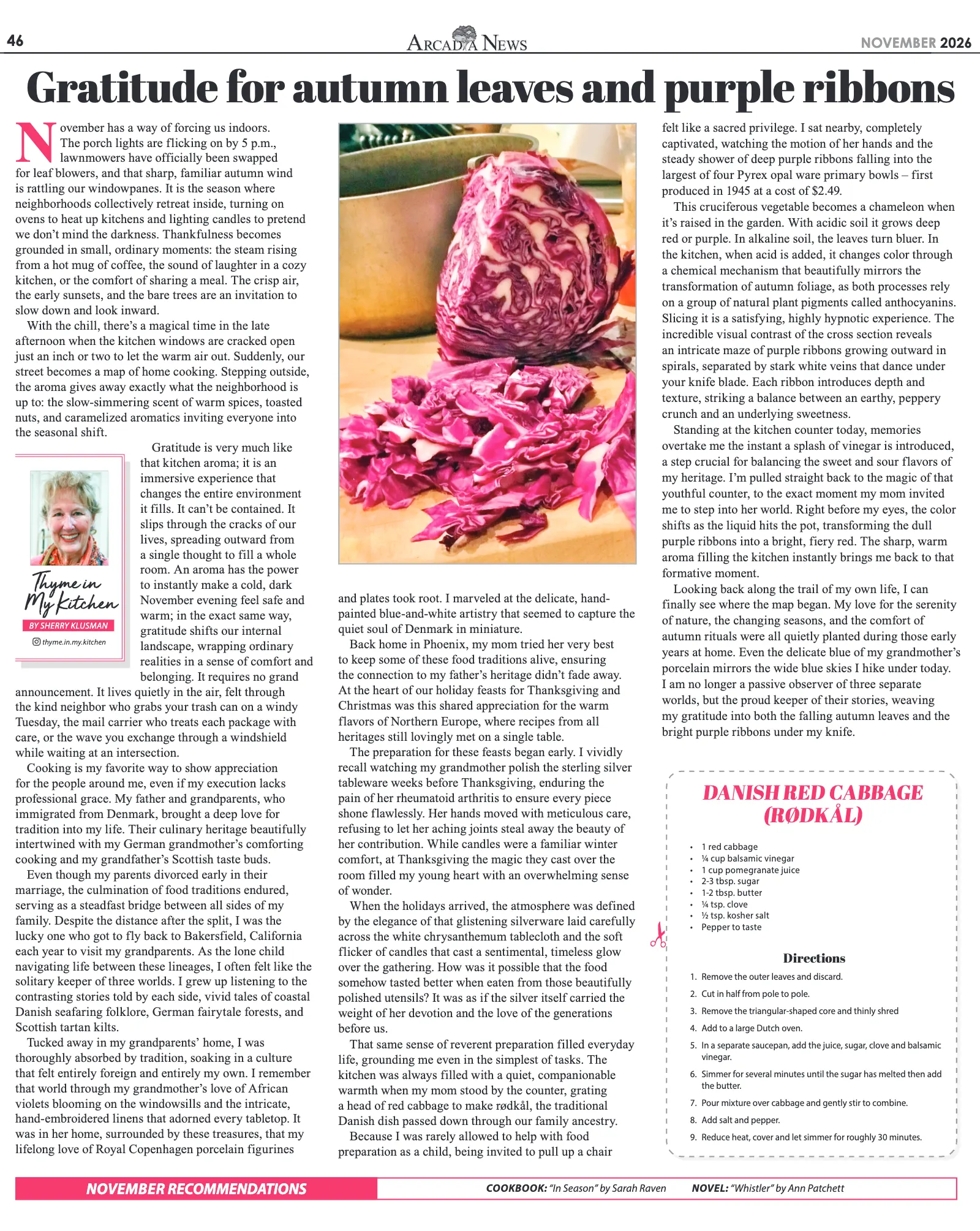

NOVEMBER 2026 46 N ovember has a way of forcing us indoors. The porch lights are flicking on by 5 p.m., lawnmowers have officially been swapped for leaf blowers, and that sharp, familiar autumn wind is rattling our windowpanes. It is the season where neighborhoods collectively retreat inside, turning on ovens to heat up kitchens and lighting candles to pretend we don’t mind the darkness. Thankfulness becomes grounded in small, ordinary moments: the steam rising from a hot mug of coffee, the sound of laughter in a cozy kitchen, or the comfort of sharing a meal. The crisp air, the early sunsets, and the bare trees are an invitation to slow down and look inward. With the chill, there’s a magical time in the late afternoon when the kitchen windows are cracked open just an inch or two to let the warm air out. Suddenly, our street becomes a map of home cooking. Stepping outside, the aroma gives away exactly what the neighborhood is up to: the slow-simmering scent of warm spices, toasted nuts, and caramelized aromatics inviting everyone into the seasonal shift. Gratitude is very much like that kitchen aroma; it is an immersive experience that changes the entire environment it fills. It can’t be contained. It slips through the cracks of our lives, spreading outward from a single thought to fill a whole room. An aroma has the power to instantly make a cold, dark November evening feel safe and warm; in the exact same way, gratitude shifts our internal landscape, wrapping ordinary realities in a sense of comfort and belonging. It requires no grand announcement. It lives quietly in the air, felt through the kind neighbor who grabs your trash can on a windy Tuesday, the mail carrier who treats each package with care, or the wave you exchange through a windshield while waiting at an intersection. Cooking is my favorite way to show appreciation for the people around me, even if my execution lacks professional grace. My father and grandparents, who immigrated from Denmark, brought a deep love for tradition into my life. Their culinary heritage beautifully intertwined with my German grandmother’s comforting cooking and my grandfather’s Scottish taste buds. Even though my parents divorced early in their marriage, the culmination of food traditions endured, serving as a steadfast bridge between all sides of my family. Despite the distance after the split, I was the lucky one who got to fly back to Bakersfield, California each year to visit my grandparents. As the lone child navigating life between these lineages, I often felt like the solitary keeper of three worlds. I grew up listening to the contrasting stories told by each side, vivid tales of coastal Danish seafaring folklore, German fairytale forests, and Scottish tartan kilts. Tucked away in my grandparents’ home, I was thoroughly absorbed by tradition, soaking in a culture that felt entirely foreign and entirely my own. I remember that world through my grandmother’s love of African violets blooming on the windowsills and the intricate, hand-embroidered linens that adorned every tabletop. It was in her home, surrounded by these treasures, that my lifelong love of Royal Copenhagen porcelain figurines and plates took root. I marveled at the delicate, hand- painted blue-and-white artistry that seemed to capture the quiet soul of Denmark in miniature. Back home in Phoenix, my mom tried her very best to keep some of these food traditions alive, ensuring the connection to my father’s heritage didn’t fade away. At the heart of our holiday feasts for Thanksgiving and Christmas was this shared appreciation for the warm flavors of Northern Europe, where recipes from all heritages still lovingly met on a single table. The preparation for these feasts began early. I vividly recall watching my grandmother polish the sterling silver tableware weeks before Thanksgiving, enduring the pain of her rheumatoid arthritis to ensure every piece shone flawlessly. Her hands moved with meticulous care, refusing to let her aching joints steal away the beauty of her contribution. While candles were a familiar winter comfort, at Thanksgiving the magic they cast over the room filled my young heart with an overwhelming sense of wonder. When the holidays arrived, the atmosphere was defined by the elegance of that glistening silverware laid carefully across the white chrysanthemum tablecloth and the soft flicker of candles that cast a sentimental, timeless glow over the gathering. How was it possible that the food somehow tasted better when eaten from those beautifully polished utensils? It was as if the silver itself carried the weight of her devotion and the love of the generations before us. That same sense of reverent preparation filled everyday life, grounding me even in the simplest of tasks. The kitchen was always filled with a quiet, companionable warmth when my mom stood by the counter, grating a head of red cabbage to make rødkål, the traditional Danish dish passed down through our family ancestry. Because I was rarely allowed to help with food preparation as a child, being invited to pull up a chair felt like a sacred privilege. I sat nearby, completely captivated, watching the motion of her hands and the steady shower of deep purple ribbons falling into the largest of four Pyrex opal ware primary bowls – first produced in 1945 at a cost of $2.49. This cruciferous vegetable becomes a chameleon when it’s raised in the garden. With acidic soil it grows deep red or purple. In alkaline soil, the leaves turn bluer. In the kitchen, when acid is added, it changes color through a chemical mechanism that beautifully mirrors the transformation of autumn foliage, as both processes rely on a group of natural plant pigments called anthocyanins. Slicing it is a satisfying, highly hypnotic experience. The incredible visual contrast of the cross section reveals an intricate maze of purple ribbons growing outward in spirals, separated by stark white veins that dance under your knife blade. Each ribbon introduces depth and texture, striking a balance between an earthy, peppery crunch and an underlying sweetness. Standing at the kitchen counter today, memories overtake me the instant a splash of vinegar is introduced, a step crucial for balancing the sweet and sour flavors of my heritage. I’m pulled straight back to the magic of that youthful counter, to the exact moment my mom invited me to step into her world. Right before my eyes, the color shifts as the liquid hits the pot, transforming the dull purple ribbons into a bright, fiery red. The sharp, warm aroma filling the kitchen instantly brings me back to that formative moment. Looking back along the trail of my own life, I can finally see where the map began. My love for the serenity of nature, the changing seasons, and the comfort of autumn rituals were all quietly planted during those early years at home. Even the delicate blue of my grandmother’s porcelain mirrors the wide blue skies I hike under today. I am no longer a passive observer of three separate worlds, but the proud keeper of their stories, weaving my gratitude into both the falling autumn leaves and the bright purple ribbons under my knife. Thyme in My Kitchen BY SHERRY KLUSMAN thyme.in.my.kitchen • 1 red cabbage • ¼ cup balsamic vinegar • 1 cup pomegranate juice • 2-3 tbsp. sugar • 1-2 tbsp. butter • ¼ tsp. clove • ½ tsp. kosher salt • Pepper to taste Directions 1. Remove the outer leaves and discard. 2. Cut in half from pole to pole. 3. Remove the triangular-shaped core and thinly shred 4. Add to a large Dutch oven. 5. In a separate saucepan, add the juice, sugar, clove and balsamic vinegar. 6. Simmer for several minutes until the sugar has melted then add the butter. 7. Pour mixture over cabbage and gently stir to combine. 8. Add salt and pepper. 9. Reduce heat, cover and let simmer for roughly 30 minutes. DANISH RED CABBAGE (RØDKÅL) Gratitude for autumn leaves and purple ribbons NOVEMBER RECOMMENDATIONS COOKBOOK: “In Season” by Sarah Raven NOVEL: “Whistler” by Ann Patchett